RoboCup Soccer is the core league of the RoboCup initiative, where autonomous robots play soccer under standardized rules.
The objective of the RoboCup Soccer leagues is to promote research and development in robotics and artificial intelligence through competitive, fully autonomous robot soccer matches.
RoboCupSoccer
Soccer League Divisions
RoboCup Soccer consists of multiple autonomous robot soccer leagues, each with its own rules, field configurations, and research focus, including Small Size, Middle Size, Humanoid Soccer League, and the Soccer Simulation (2D and 3D) leagues.
NewLeague
RoboCup is preparing a new unified humanoid soccer league for 2026.
According to the official RoboCup announcement, the Standard Platform League and the Humanoid League KidSize are undergoing a merger process to form a single league. The final name and competition structure will be announced by the RoboCup Federation.
The new league focuses on fully autonomous humanoid robots playing soccer using onboard perception, locomotion, and decision-making, addressing key research challenges such as balance, vision, self-localization, and team coordination.

Humanoid
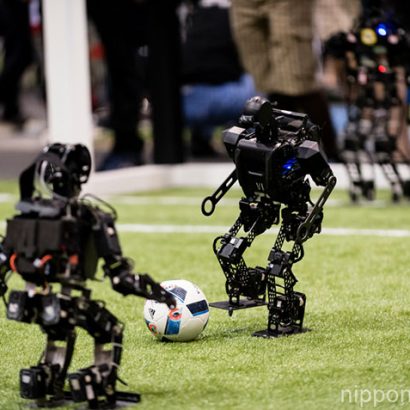
In the Humanoid League, autonomous robots with a human-like body plan and human-like senses play soccer against each other. Unlike humanoid robots outside the Humanoid League the task of perception and world modeling is not simplified by using non-human like range sensors. In addition to soccer competitions technical challenges take place. Dynamic walking, running, and kicking the ball while maintaining balance, visual perception of the ball, other players, and the field, self-localization, and team play are among the many research issues investigated in the Humanoid League. Several of the best autonomous humanoid robots in the world compete in the RoboCup Humanoid League.
Small Size
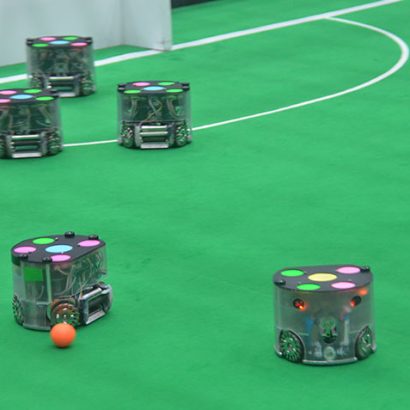
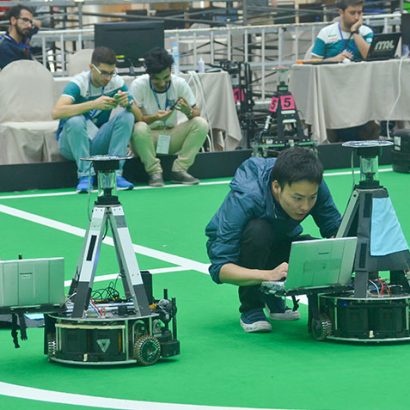
The RoboCup Small Size League is one of the oldest RoboCup Soccer leagues. It is focused on intelligent multi-agent coordination and control in a highly dynamic environment. Teams currently compete in 11 vs. 11 soccer matches (6 vs. 6 in division B) with an orange golf ball. The robots are built by the teams and have to conform to certain dimensions and constraints, as defined in the rules. All objects on the field are tracked by a central vision system – called SSL-Vision – which is maintained by the SSL community. Off-field computers for each team are used for the processing required for coordination and control of the robots. Communication is wireless and uses dedicated commercial radio transmitter/receiver units.
Middle Size
In RoboCup MSL teams of five fully autonomous robots play soccer with a regular size FIFA soccer ball. Teams are free to design their own hardware but all sensors have to be on-board and there is a maximum size and weight for the robots. The research focus is on mechatronics design, control and multi-agent cooperation at plan and perception levels.
Simulation
This is one of the oldest leagues in RoboCupSoccer. The Simulation League focus on artificial intelligence and team strategy. Independently moving software players (agents) play soccer on a virtual field inside a computer. There are 2 subleagues: 2D and 3D.